Why Crawling and Hanging in the Same Session Cancel Each Other Out
Quick Answer: Crawling and hanging both load the shoulder girdle, grip and wrists heavily, and they fatigue in the same order. Doing them back to back means the second one is performed with compromised tissue, which is where wrist and shoulder complaints come from. Either separate them by 48 hours, or put hanging first and cap crawling at short, quality sets — never the reverse.
You added both to your week because both are genuinely worth doing.
Six weeks later your hang time has not moved, your wrists ache on the second crawl, and the shoulder that felt great in month one now clicks.
The programme is not too advanced. It is just internally contradictory — two exercises quietly competing for the same limited resource.

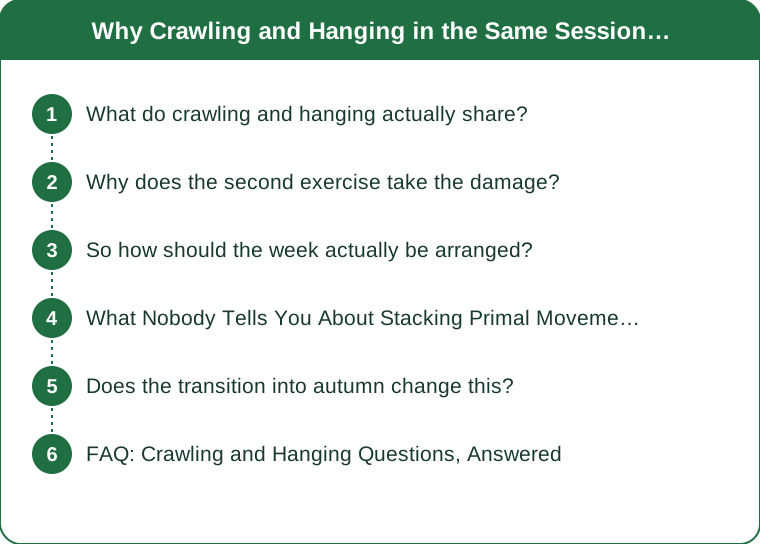
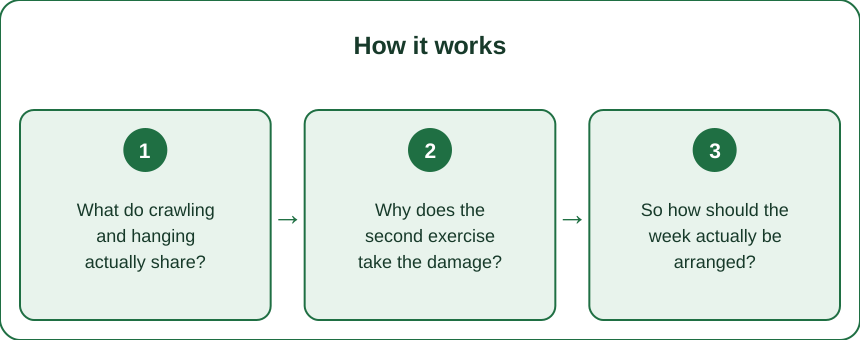
What do crawling and hanging actually share?
More than the movement patterns suggest.
Grip and forearm. Hanging is obviously grip-limited. Crawling is too — the hand is bearing load through an open palm, and the forearm flexors work continuously to stabilise the wrist. Grip endurance is a single shared pool.
Scapular control. Both movements are essentially about controlling the shoulder blade under load with a straight-ish arm. Hanging trains it in overhead flexion; crawling trains it in a loaded, closed-chain push position. Same muscles — serratus anterior, lower trapezius, rotator cuff — different angles.
Wrist extension under load. Crawling holds the wrist near end-range extension while bearing weight. Hanging loads the wrist and hand in traction. The tissue is the same; the direction differs.
Connective tissue recovery. This is the one people miss. Tendon and fascia adapt more slowly than muscle — often needing 48 to 72 hours where muscle needs 24 to 48. Two high-demand loads on the same connective tissue inside one session compresses recovery from both.
Why does the second exercise take the damage?
Because fatigue changes technique before it changes capacity.
When grip fatigues, your hand position drifts. In a hang, that means less active shoulder packing and more passive hanging on the joint capsule. In a crawl, it means the wrist collapsing further into extension and the elbow softening.
Neither feels dramatic. You still complete the sets. But you have completed them in a slightly worse position, and position under load is what determines whether an exercise builds tissue or irritates it.
There is a measurable version of this: grip strength after a demanding hanging session can remain reduced for hours, not minutes. Crawling on that grip is crawling with a compromised base.
Order matters more than volume here. Two sessions with identical total work but different order produce noticeably different outcomes, because the exercise that goes second is always performed in the worse state.
So how should the week actually be arranged?
Three workable structures, in order of preference:
Option 1 — Separate days (best). Hanging on Monday and Thursday, crawling on Tuesday and Friday. Each gets fresh tissue, and each gets 72 hours between exposures.
Option 2 — Same session, hang first, crawl short. Hanging while fresh, then crawling capped at 3 sets of 20 metres with full rest. Hang first because hanging is the more position-sensitive of the two, and because it degrades faster with pre-fatigue.
Option 3 — Alternating emphasis blocks. Three weeks emphasising hanging with crawling as a light warm-up, then three weeks the other way round. This suits people who genuinely only train twice a week.
What does not work: long crawling circuits followed by hang holds to failure. That is the standard structure in a lot of primal-style class formats, and it is precisely backwards.

What Nobody Tells You About Stacking Primal Movements
Wrists are the real bottleneck, not shoulders. Most people can build shoulder tolerance faster than wrist tolerance, so the wrist is what caps progress. It also complains latest — usually a day after, which makes it hard to connect to the session that caused it.
Chalk hides fatigue. Chalk extends grip endurance by improving friction, which means you keep hanging past the point where your shoulder control has degraded. Useful for performance, misleading for programming.
Crawling is more cardiovascular than it looks. Bear crawls raise heart rate faster than jogging for most people, and cardiovascular fatigue degrades fine motor control in the hands. Some of what feels like grip failure in a stacked session is actually general fatigue.
Barefoot crawling adds a variable. Bare feet increase toe and calf involvement, which is a genuine benefit, but it also increases total session demand. Introduce it in a block where you are not also pushing hanging volume.
Surface changes everything. Carpet increases friction and shoulder demand; smooth hard floor increases sliding and core demand. Changing the surface is effectively changing the exercise.
Does the transition into autumn change this?
It does, mostly through temperature.
Cool air stiffens tendon and fascia, and both crawling and hanging load exactly that tissue in end-range positions. A garage or outdoor bar session in 12°C air needs a genuinely longer warm-up than the same session in August.
Practical adjustments as the mornings cool:
- Add 5 to 8 minutes of wrist and shoulder preparation — wrist circles, loaded wrist rocks on the floor, dead hangs at 50% before working hangs.
- Move outdoor hanging later in the day if you can. Cold bars are slippery, and cold hands lose grip endurance sharply.
- Reduce crawling volume by around 20% in the first two weeks of a temperature drop, then rebuild. The tissue adapts, but not instantly.
If you train outdoors, this is also the point in the year to check bar surfaces. Damp metal in September is a different grip proposition from dry metal in July.
FAQ: Crawling and Hanging Questions, Answered
How much hanging is enough?
For general shoulder health, accumulating 60 to 120 seconds of quality hang time across two or three sessions a week does most of the work. Total accumulated time matters more than any single long hold.
Can I do them on the same day if one is very light?
Yes. A light exposure — a couple of 20-second hangs or 20 metres of easy crawling — used as a warm-up is not a competing load. The rule applies to two genuinely demanding efforts.
Which should I prioritise if I only have time for one?
Hanging, for most desk-bound adults. It addresses overhead position and grip, both of which decline with sedentary living, and it needs less floor space and less time.
This is general information, not medical advice. Shoulder or wrist pain that persists between sessions, or that appears at rest, should be assessed by a professional rather than trained through.
TL;DR:
- Crawling and hanging compete for the same grip, wrist, scapular control and connective tissue — they are not complementary, they are overlapping.
- Whichever goes second is performed with degraded position, and position is what decides whether load builds or irritates.
- Best structure is separate days; if they must share a session, hang first and cap crawling at short quality sets.
- Cool autumn air stiffens the exact tissue both movements stress, so extend the warm-up and trim crawling volume by about 20% during the transition.
Both movements deserve a place in your week. They just do not deserve the same hour.
Keep Reading
This article is for general informational and styling purposes only. Fit, sizing, and product availability may vary.