Why Your Ankles Decide How Long You Can Sit on the Floor
Quick Answer: Most floor-sitting positions load the ankle at or near its end range — kneeling demands full plantarflexion, the deep squat demands deep dorsiflexion, and cross-legged loads the outside of the ankle. If any of those ranges is limited, the ankle becomes the first joint to complain, usually within 5 to 10 minutes, and you shift or stand before your hips ever get a say. Build ankle range and floor sitting gets dramatically easier without touching your hips at all.
This is why people who have spent months on hip mobility still cannot sit on the floor comfortably.
They have been working on the joint that was not the limiter.

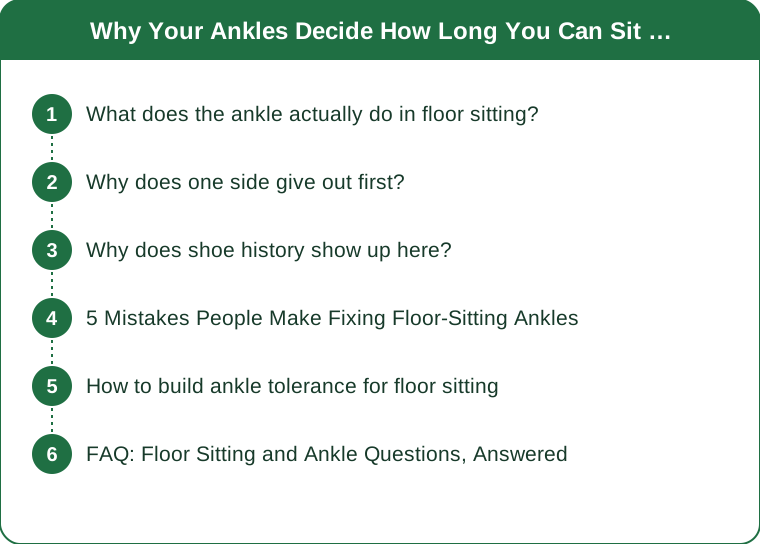
What does the ankle actually do in floor sitting?
Something different in every position, and something demanding in all of them.
Kneeling (seiza). The top of the foot is flat on the floor, which requires near-full plantarflexion — pointing the foot. If your ankle stops short of that, the front of the ankle and the top of the foot take the strain, and it becomes uncomfortable fast. Many people cannot get the foot flat at all and end up on their toes, which is a different position entirely.
Deep squat. This needs substantial dorsiflexion — knee travelling forward over the toes. Adults commonly have 30 to 40 degrees available, and the deep squat wants closer to the top of that range with the heel down.
Cross-legged. Less dramatic, but the outside of the ankle is loaded against the floor and the foot is held in an inverted position for the whole time.
Side sitting. One ankle is plantarflexed, the other is compressed underneath.
So every ground position has an ankle requirement, and it is usually closer to end range than the hip requirement is.
Why does one side give out first?
Because ankle history is almost always asymmetric.
Almost everyone has sprained one ankle more than the other. A sprain that healed fine still commonly leaves a small loss of dorsiflexion and some altered joint mechanics on that side — and that loss can persist for years without ever being noticeable in walking, because walking needs only about 10 degrees.
Floor sitting needs much more, which is why an old injury you had genuinely forgotten shows up here first. The pattern is recognisable: you sit cross-legged and one ankle aches while the other is fine, or you kneel and one foot goes flat while the other stays angled.
The other common source of asymmetry is habit. If you always cross the same leg on top, that ankle has been living in one position and the other in a different one for years.
Worth checking with a simple test: kneel on both shins and see whether both feet lie flat. Then do a knee-to-wall dorsiflexion test on each side. Any obvious difference between sides tells you where to start.
Why does shoe history show up here?
Because a heel does the ankle’s job for it, for years at a time.
A raised heel — and almost all shoes have one, typically 8 to 12mm even in a trainer — puts your ankle into slight plantarflexion for every step you take. That means the top of the dorsiflexion range is rarely used, and range that is not used gradually becomes range that is not available. The calf and Achilles adapt to the shortened position too.
This is not an argument that shoes ruined your ankles. It is an observation that if you have spent thirty years in shoes with a heel, your ankle has not been asked for deep dorsiflexion in a long time, and floor positions ask for it immediately.
The practical implication is about rate, not about footwear choice. The range is recoverable — ankle mobility responds well to consistent loading — but not in a week. Expect meaningful change over six to eight weeks of near-daily short exposures, and expect the first two weeks to feel like nothing is happening.

5 Mistakes People Make Fixing Floor-Sitting Ankles
1. Stretching the calf and stopping there. A tight calf is one limiter. Restricted movement at the front of the ankle joint is another, and stretching does nothing for it. You need loaded movement into the range, not just static stretching.
2. Going straight to the floor with no support. A cushion under the hips or ankles reduces the demand enough that you can actually accumulate time in the position, and accumulated time is what changes tissue.
3. Holding one position until it hurts. The goal is frequent short exposures, not endurance. Five minutes, four times a day, beats twenty minutes once.
4. Ignoring the front of the ankle in kneeling. If kneeling is the hard one for you, the limiter is plantarflexion and the top of the foot, and no amount of squat work addresses it.
5. Expecting a change in two weeks. The third mistake is the one that traps most people — they hold the position long enough to make it unpleasant, so they stop doing it daily, and daily was the whole mechanism.
How to build ankle tolerance for floor sitting
Small, frequent, and boring. In that order.
Daily, 5 to 10 minutes total:
- Kneeling with a rolled towel under the ankles. Start at 60 seconds, build to three minutes. Reduce the towel thickness over weeks
- Supported deep squat. Hold a doorframe, heels down, sit as low as comfortable. 30 to 60 seconds, three times
- Knee-to-wall drives. Foot flat, drive the knee forward over the toes, 10 reps each side. This loads dorsiflexion actively, which does more than passive stretching
- Toe-flat kneeling to seated rock. Rock gently back onto the heels, 10 slow reps
And the part that matters most: actually sit on the floor during ordinary life. Watch something, read, eat a meal down there. Change position every few minutes rather than committing to one. Rotating between cross-legged, side sitting, kneeling, and squatting spreads the demand across different ankle positions and lets you accumulate far more total time.
A cushion is not cheating. Sitting on the edge of a firm cushion tips the pelvis forward, takes load off the ankles, and buys you the time in position that drives the adaptation.
This is general information, not medical advice. If you have had a significant ankle injury, or you get sharp pain rather than a stretch, get it assessed properly.
FAQ: Floor Sitting and Ankle Questions, Answered
How do I know if my ankles or my hips are the limiter?
Sit cross-legged on a cushion high enough that your knees drop below your hips. If it becomes comfortable, the hips were involved. Then kneel with a towel under your ankles — if that fixes kneeling, the ankle was the problem. Testing each in isolation answers it in about two minutes.
My feet go numb when I sit on the floor. Is that the ankle?
Usually it is compression rather than mobility — the position is pressing on nerves or restricting blood flow, most often in cross-legged or side sitting. Change position more often and try a cushion. Numbness that persists after you stand, or that happens in normal activity, is worth getting checked.
How long until floor sitting is comfortable?
With daily short exposures, most people notice a real difference in four to six weeks and a substantial one by three months. The change is slow and then suddenly obvious, usually when you realise you have been sitting down there for twenty minutes without thinking about it.
TL;DR:
- Every floor-sitting position loads the ankle near end range — kneeling needs plantarflexion, squatting needs dorsiflexion
- Old sprains and always-the-same-crossed-leg habits make one side the limiter
- Years in heeled shoes leave dorsiflexion unused and therefore unavailable
- Short daily exposures with a cushion or towel beat long uncomfortable holds
- Expect four to six weeks before it starts to feel easy
If you have been working on your hips for months and the floor is still uncomfortable, spend two minutes testing your ankles. It is a common enough pattern that it is worth ruling out before you spend another month on the wrong joint.
Keep Reading
This article is for general informational and styling purposes only. Fit, sizing, and product availability may vary.