Get Off the Couch (Onto the Floor): The Ground-Sitting Rotation
Quick Answer: Sitting on the floor forces you to change position every few minutes, and that variety is what maintains hip range of motion. Rotate through cross-legged, 90/90 both directions, long-sit, side-sit, and kneeling — holding each until it complains, then switching. Start with 10-minute doses, put a cushion under your hips (this is legal and unlocks most positions), and count every stand-up as the free exercise it is.
The couch made one deal with you: comfort now, hips later.
Floor-sitting cultures — the ones with the startling old-age mobility statistics, where people in their seventies get up from the ground without using their hands — never signed it.
The ground-sitting rotation brings that deal home. TV time on the floor, positions rotating every few minutes, hips quietly maintained by a small act of furniture refusal.

Is Sitting Really the Problem?
Not quite. Sitting one way for decades is.
The chair is a remarkably static object. It supports your back, holds your hips at exactly 90 degrees, and asks nothing of you — so you can occupy the same position for three hours without your body registering a complaint until you stand up.
Floor sitting is structurally incapable of that. There’s no backrest, no consistent support, and no position that stays comfortable for long. So you shift. Every few minutes, you visit a different hip range without deciding to.
The fidgeting is the feature. The couch’s stillness was the bug. It’s not that floor sitting is a magical posture — it’s that it’s a posture you can’t hold, and the constant switching is what keeps the joints moving through their available range.
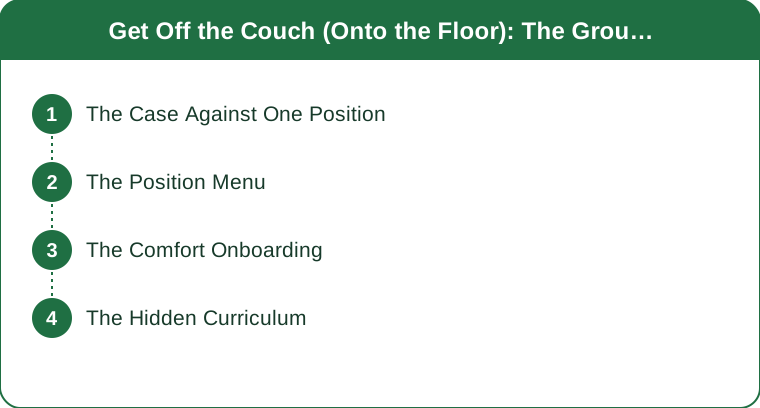
The Position Menu
Six positions, rotating. Each held until it complains, then switch.
Cross-legged. The default. External hip rotation, and the one most people can already do. If your knees sit high above your hips, put a cushion under your sit bones.
90/90. One leg in front bent at 90 degrees, the other out to the side bent at 90. This is the highest-value position on the list — it works internal rotation on one hip and external on the other simultaneously. Do both directions, and expect one side to be noticeably worse. That asymmetry is normal and it’s information.
Long-sit. Legs straight out in front, sitting upright. Honest hamstring feedback, immediately. Most people can’t sit upright here without rounding, and a cushion under the hips helps enormously.
Side-sit. Both legs folded to one side, like a mermaid pose. Alternate sides. It hits hip rotation from a different angle than 90/90.
Kneeling (seiza). Sitting back on your heels. Quads, ankles, and the front of the shins. Start with a cushion between your heels and your seat, or a rolled towel under the ankles.
Deep squat. The ambitious cameo. Feet flat, hips down, holding for 30 seconds to a few minutes. Hold onto something in front of you if your heels lift, and don’t force it — this one takes months for a lot of adults.

The Comfort Onboarding
Adult floor-sitting starts uncomfortable, and how you handle the first few weeks determines whether you keep going.
The cushion under the hips is legal. Actually, it’s more than legal — raising your hips a few inches unlocks most of these positions for most people. A firm cushion, a folded blanket, or a yoga block. This isn’t cheating; it’s the standard way to make the positions accessible while the tissue adapts.
The wall as an occasional backrest is legal too. Especially in long-sit, where an upright spine is genuinely hard at first.
Ten-minute doses beat two-hour heroics. One episode, or one phone call, or one stretch of reading. Comfort expands weekly if you’re consistent, and it collapses entirely if your first session leaves you sore for three days.
Move before it hurts, not after. The signal to switch is mild discomfort or numbness starting, not pain. Numbness or pins and needles means change position now — sustained pressure on a nerve isn’t building anything.
A few caveats. If you have a knee replacement, a recent hip or knee injury, or significant arthritis in those joints, check with a physical therapist about which positions are appropriate — kneeling and deep squatting in particular. Sharp joint pain, as opposed to muscular stretch, means come out of the position.
The Hidden Curriculum: Getting Up
Every floor session ends with the actual exercise, and it’s the one nobody plans for: getting up.
If you sit on the floor for an evening and get up four or five times — for water, for the door, for the remote you left on the couch — you’ve done a set of loaded, real-world get-ups without scheduling anything.
This matters more than it sounds like it should. The ability to get down to and up from the floor without using your hands is a well-studied marker of functional mobility, and it declines quietly in adults who never practice it. Floor-sitting cultures never trained get-ups. They just never stopped doing them.
Try varying how you get up. Sometimes from cross-legged, sometimes from a kneel, sometimes from a side-sit. Different entries and exits load different patterns. Using your hands is completely fine — the goal is doing it often, not doing it heroically.
The couch can keep the guests. The floor keeps the hips.
What Nobody Tells You
Your first two weeks will feel like nothing is happening. Then around week three you’ll notice you’re shifting less often, which is the adaptation showing up.
One side will be worse and it will stay worse for a while. Most people have a clear asymmetry in 90/90. Spend a bit more time on the harder side rather than avoiding it.
Ten minutes daily beats an hour on Sunday. Frequency drives adaptation in connective tissue far more than duration does.
It’s not a replacement for strength training or walking. It’s mobility maintenance — a genuinely useful category, but it’s not cardio and it’s not resistance training.
A firm surface helps. A thick plush rug is more comfortable but gives you less feedback and makes some positions unstable. A thin rug or a yoga mat on a firm floor works better.
Mini FAQ
Is sitting on the floor better than sitting in a chair?
For hip and ankle mobility, yes — mainly because floor sitting forces frequent position changes where a chair permits three hours of stillness. It isn’t better for sustained desk work, and it isn’t a posture cure. Think of it as movement variety rather than a superior sitting position.
How long should you sit on the floor each day?
Start with 10 minutes daily and build gradually toward 30–60 minutes across the day. Frequency matters more than any single session’s length, and short daily doses adapt tissue better than occasional long ones.
What is 90/90 sitting good for?
It trains internal rotation in one hip and external rotation in the other at the same time, which covers a range most adults lose to chair sitting. Do both sides — the asymmetry between them is usually noticeable and is worth working on directly.
TL;DR:
- Sitting isn’t the problem; sitting one way for hours is. Floor sitting forces variety.
- Rotate: cross-legged, 90/90 (both ways), long-sit, side-sit, kneeling, deep squat.
- A cushion under the hips is legal and unlocks most positions. So is the wall.
- Ten-minute doses daily. Switch at mild discomfort, not pain. Numbness means move now.
- Every stand-up is a free get-up rep — vary how you do them.
Cushion under hips, positions on rotation, get-ups as the free finale. The floor was never the downgrade — it’s a mobility program disguised as furniture minimalism, one episode at a time.
Keep Reading
This article is for general informational and styling purposes only. Fit, sizing, and product availability may vary.