Why Primal Movement Practice Sometimes Causes Knee Pain (And What Actually Fixes It)
Quick Answer: Knee discomfort during primal movement work most often shows up in deep, sustained flexion positions (like extended low crawls or deep squats) and typically points to a mobility gap somewhere else in the chain — hips or ankles — forcing the knee to compensate, rather than the knee itself being the actual source of the problem.
The knee is frequently where the discomfort shows up, but it’s rarely where the underlying limitation actually is.

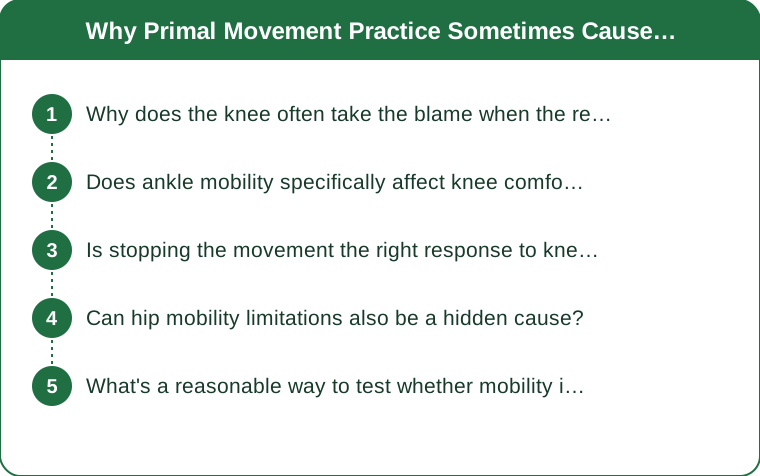
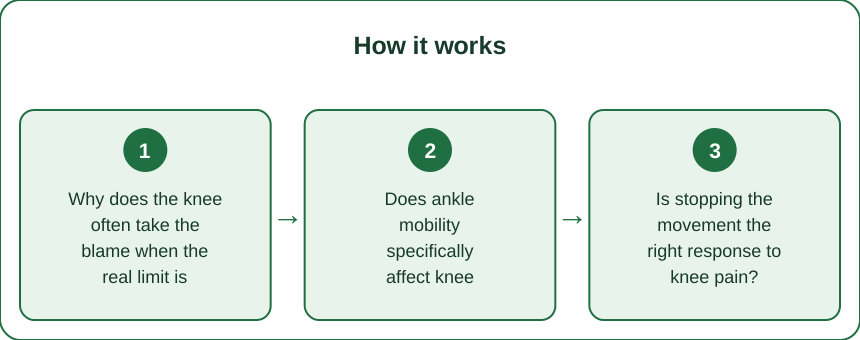
Why does the knee often take the blame when the real limit is elsewhere?
Deep primal positions require significant mobility through the ankles and hips, and when either is restricted, the body often finds the missing range of motion by compensating through the knee joint instead, which isn’t designed to comfortably absorb that kind of compensatory load over repeated sessions.
Does ankle mobility specifically affect knee comfort in these positions?
Yes, substantially — a deep squat or low crawl position requires meaningful ankle dorsiflexion, and when that range is limited, the knee is often pushed further forward or into an awkward angle to compensate, which is a well-documented contributor to knee discomfort in deep-flexion movement practices.

Is stopping the movement the right response to knee pain?
For sharp or persistent pain, yes, temporarily, and a professional opinion is worth getting — but for mild, position-specific discomfort, working on ankle and hip mobility separately, then gradually reintroducing the position, often resolves the issue more effectively than avoiding the movement pattern indefinitely.
Can hip mobility limitations also be a hidden cause?
Yes — restricted hip internal or external rotation can similarly force compensatory movement through the knee during rotational or low-to-ground primal patterns, meaning a targeted hip mobility assessment is often as useful as an ankle-focused one when troubleshooting recurring knee discomfort.
What’s a reasonable way to test whether mobility is the real issue?
Practicing the specific position that causes discomfort in a much shallower, less demanding range first, and gradually working toward full depth over several weeks, tends to reveal whether the issue resolves as mobility improves — if it does, that’s a strong sign the knee was compensating for a mobility gap rather than being the actual source of the problem.
TL;DR:
- Knee discomfort in deep primal positions often reflects a mobility gap elsewhere
- Limited ankle dorsiflexion is a common, specific contributor to knee compensation
- Hip rotation limitations can similarly force compensatory knee movement
- Gradually building depth as mobility improves helps confirm the actual cause
This is general information, not medical advice — sharp or persistent knee pain deserves a professional assessment before continuing.
Keep Reading
This article is for general informational and styling purposes only. Fit, sizing, and product availability may vary.