Why Most Adults Quietly Lose the Ability to Deep Squat Without Ever Noticing
Quick Answer: Adults lose the deep squat through disuse, not aging. Ankle, hip, and thoracic mobility each decline slightly through years of chairs, car seats, and heeled shoes — and because nothing in a modern day demands a full squat, nobody notices until they try. Restricted ankle dorsiflexion is usually the first blocker. Short daily supported holds plus ankle-specific work rebuilds it faster than hip stretching alone.
Try it right now. Squat all the way down, heels flat on the floor, and rest there.
If your heels lift, or you topple backward, or your lower back rounds hard — you’re in the majority.
Here’s the strange part: you could do this effortlessly as a toddler, and you cannot name the year you stopped. Nobody can. That’s the whole story of how it happens.

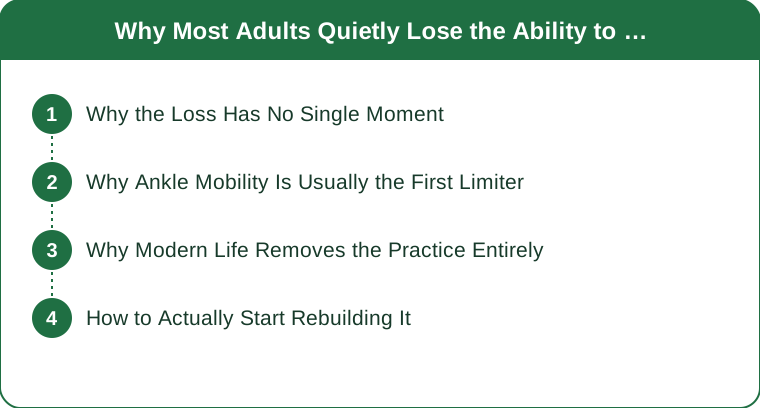
Why Can’t You Remember Losing the Deep Squat?
Because there was never a moment to remember.
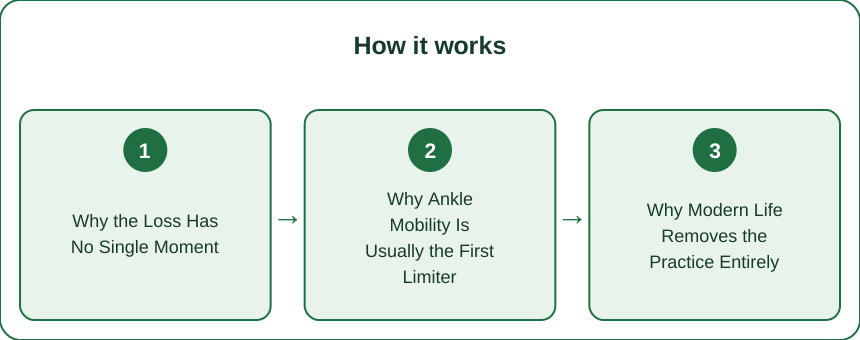
Three separate joints each lose a small amount of range independently and gradually — the ankle, the hip, and the thoracic spine. None of those individual losses is noticeable. A degree or two of ankle dorsiflexion per year doesn’t announce itself.
And crucially, nothing tests it. A modern day involves sitting in a chair, sitting in a car, standing at a counter, and lying in a bed. Not one of those positions requires a heels-down full squat. You can go a decade without attempting one.
So the capacity quietly drains out while the demand stays at zero — and the gap only becomes visible the day something makes you try. Usually a yoga class, a toddler who wants you on the floor, or an article like this one.
By then the loss looks sudden. It wasn’t. It took fifteen years.
Why Is Ankle Mobility Usually the First Thing That Blocks It?
Because a deep squat requires your shin to travel forward over your foot, and that’s the range most restricted by modern life.
The technical term is ankle dorsiflexion — the angle between your shin and the top of your foot as the knee travels forward. A full heels-down squat needs roughly 35–40 degrees. Many adults have 15–25.
Where it goes:
- Shoes with any heel lift — including most running shoes, which typically have an 8–12mm drop — keep the ankle in slight plantarflexion all day.
- Sitting means the ankle sits at a fixed 90 degrees for hours, never approaching end range.
- Calf and Achilles tissue shortens to the range it habitually occupies.
The test: kneel with one foot flat on the floor in front of you, toes about 5 inches from a wall. Drive your knee forward toward the wall without lifting the heel. If the knee touches at 5 inches, your dorsiflexion is fine. If you have to move the foot closer, that’s your limitation in inches.
Most people discover the ankle is their blocker before hip tightness even becomes relevant — which is exactly why hip-focused stretching so often fails to fix a squat.

Is Losing the Deep Squat Just Part of Aging?
Largely no — it’s disuse wearing the costume of aging.
The clearest evidence is cultural. In populations where floor-sitting and resting squats remain part of daily life, adults retain the position well into their seventies and eighties. The joints didn’t age differently. The demand simply never stopped.
Compare that to a chair-based population, where the same position vanishes by the thirties.
What genuinely does change with age: tissue becomes slightly less elastic, and recovery from loading takes longer. Those are real. They’re also far smaller factors than twenty years without the position.
The practical implication is good news. Disuse is reversible in a way that aging isn’t. If you lost it by not doing it, you can substantially get it back by doing it — and the timeline is months, not years.
The 5 Mistakes People Make Trying to Get the Deep Squat Back
- Stretching only the hips. The most common error. If the ankle is your limiter, hip stretching produces almost no change in your squat depth, which people interpret as “I just can’t do this.”
- Trying it unsupported from day one. Falling backward repeatedly teaches your nervous system that the position is unsafe. Hold a doorframe. Supported reps still count.
- Going for long single holds instead of frequent short ones. Three minutes once a week does far less than 30 seconds five times a day. Connective tissue responds to repetition.
- Forcing the heels down before the range exists. Elevating the heels on a 1-inch book is not cheating — it lets you actually occupy the position while the ankle catches up. Lower the elevation over weeks.
- Quitting at week two because nothing changed. This is the one that gets nearly everyone. Meaningful ankle range change takes 6–8 weeks of daily work, and week two feels identical to week one.
How Do You Actually Rebuild the Deep Squat?
Two components, done daily, about five minutes total.
Component 1 — The supported hold. Hold a doorframe, a squat rack upright, or a heavy table edge. Lower into the deepest squat you can manage with heels down (or on a small elevation). Sit there. Let the hips relax rather than gripping.
Dose: accumulate 60–90 seconds daily. Break it into 3 or 4 holds if a single one is too much.
Component 2 — Ankle dorsiflexion work. The knee-to-wall drill: kneel with one foot flat, drive the knee forward over the toes toward a wall, hold 2 seconds, return. 15 reps per side. Keep the heel glued down — that’s the entire exercise.
Add a calf stretch off a step, 30 seconds per side, if your calves are notably tight.
Progression: start with heels on a 1-inch elevation if needed. Every two weeks, reduce it. Most people are flat on the floor within 8–12 weeks.
Two useful extras: deep squat to sit-and-reach (rocking gently forward and back in the bottom position) trains the range actively rather than passively, and simply choosing to sit on the floor rather than a chair for 15 minutes an evening reintroduces the demand your day removed.
Frequently Asked Questions
Why do my heels lift when I squat?
Almost always restricted ankle dorsiflexion — your shin can’t travel far enough forward over your foot, so your body compensates by rotating up onto the toes. Test it with the knee-to-wall drill. Tight calves and Achilles tissue are the usual cause, and both respond well to daily work.
How long does it take to regain deep squat mobility?
Most people see meaningful improvement in 8–12 weeks of daily practice, with the first noticeable change around week 4–6. Nervous-system adaptation comes first (your body allowing more range), followed by slower tissue change. Progress stalls if practice becomes weekly rather than daily.
Is it bad if I can’t squat all the way down?
It’s not dangerous, but it does indicate reduced mobility across several joints, which tends to show up elsewhere — as compensation in the lower back when bending, or knee tracking issues under load. It’s worth working on for that reason, not because the squat position is inherently required.
Can everyone achieve a full deep squat?
Most people can, but not all. A minority have hip socket geometry — a deeper or differently-angled acetabulum — that mechanically limits depth regardless of soft tissue work. If you feel a hard, bony block at the front of the hip rather than a stretch, that may be structural and worth having assessed.
When to Check With a Professional
Sharp pinching at the front of the hip during a deep squat can indicate femoroacetabular impingement, which is a structural issue that forcing depth may aggravate rather than improve. Knee pain that’s sharp rather than a stretch sensation, and any pain that lingers after you stand up, also warrant assessment.
If you have a hip or knee replacement, a history of labral tear, or persistent pain that hasn’t shifted after six weeks of consistent work, see a physiotherapist. A single assessment will usually tell you whether you’re dealing with a soft-tissue restriction you can train or a bony one you can’t.
TL;DR:
- The deep squat disappears gradually because ankle, hip, and thoracic range each decline slightly and nothing in a chair-based day tests it.
- Restricted ankle dorsiflexion is usually the first and biggest blocker — often before hip tightness matters at all.
- It’s disuse, not aging: populations that keep floor-sitting keep the squat into their seventies.
- Rebuild with 60–90 seconds of supported holds daily plus 15 knee-to-wall reps per side.
- Elevate heels on a book if needed and lower it over weeks. Expect 8–12 weeks, and don’t quit at week two.
Keep Reading
This article is for general informational and styling purposes only. Fit, sizing, and product availability may vary.