Why Adults Quietly Lose the Deep Squat Without Ever Noticing It Happening
Quick Answer: Deep squat mobility fades gradually through years of prolonged sitting in chairs, which shortens hip flexors and stiffens ankle dorsiflexion range, and because the loss happens in tiny increments over years rather than all at once, most adults never register a specific moment when the position stopped being accessible — it simply becomes less used, then less possible, without ever feeling like a loss.
No single day marks when the deep squat disappeared. It just quietly stopped being something the body offered — and years of chairs are usually why.

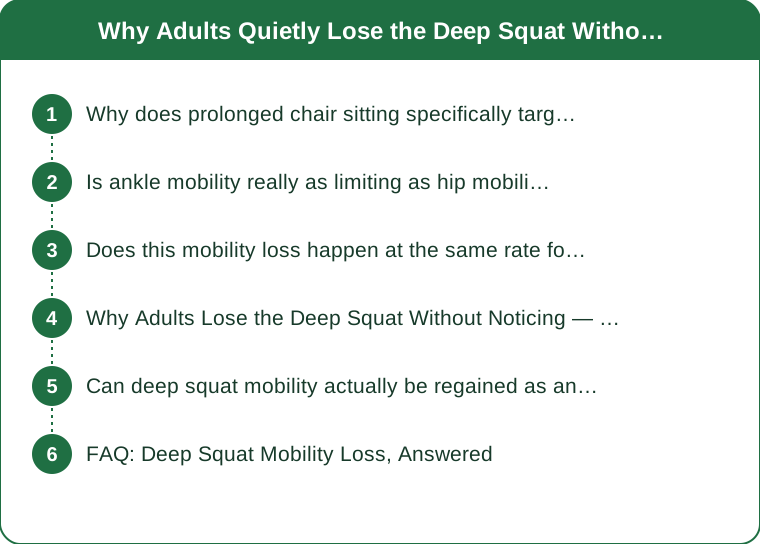
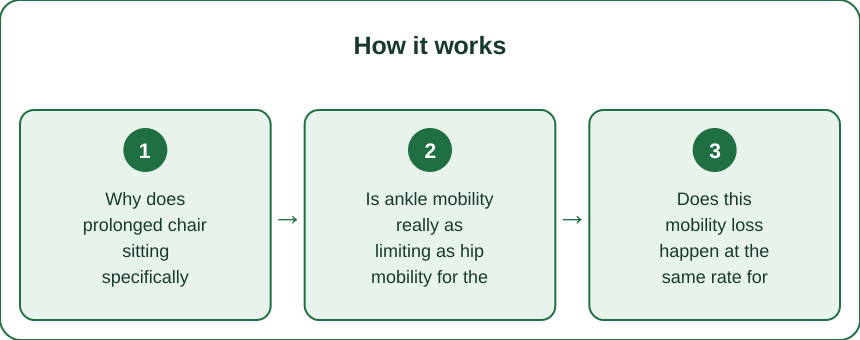
Why does prolonged chair sitting specifically target the deep squat position?
Chairs consistently position hips and ankles in ranges very different from a deep squat — hips stay near 90 degrees rather than fully flexed, and ankles rarely dorsiflex — and the body adapts to whatever range gets used most consistently, meaning years of near-constant chair use gradually trains hip and ankle tissue toward chair-range mobility and away from deep-squat range.
Is ankle mobility really as limiting as hip mobility for the deep squat?
For a large number of adults, ankle dorsiflexion range is actually the more limiting factor, since a deep squat requires the knee to travel forward over the toes, and restricted ankle mobility forces the torso to lean forward or the heels to lift to compensate, often before hip tightness even becomes the primary limiter.
Does this mobility loss happen at the same rate for everyone, or does activity level change it?
Activity level makes a real difference — people who regularly sit on the floor, garden, or do manual work that involves deep hip and knee flexion tend to retain more of this range into adulthood, while a consistently desk-and-car lifestyle accelerates the gradual loss regardless of general fitness level in other areas.

Why Adults Lose the Deep Squat Without Noticing — What Nobody Tells You
The loss is rarely framed as ‘losing mobility’ in daily life because the body simply substitutes other movement patterns — bending at the waist instead of squatting to pick something up — so smoothly that the actual range disappears without ever registering as a noticeable functional limitation until someone specifically tries a full squat again.
Can deep squat mobility actually be regained as an adult, or is it permanently lost past a certain point?
For most adults without underlying joint pathology, deep squat range can be meaningfully regained through consistent ankle and hip mobility work over weeks to months, since the limitation is typically tissue adaptation to disuse rather than a structural or permanent change, though older or previously injured joints may have a lower ceiling for full range.
FAQ: Deep Squat Mobility Loss, Answered
How long does it typically take to regain a comfortable deep squat with consistent practice?
Many people notice meaningful improvement within 4-8 weeks of consistent daily ankle and hip mobility work, though a fully comfortable, sustained deep squat can take several months depending on starting mobility and joint history.
Is heel elevation (using a wedge or weight plates) a legitimate way to work around limited ankle mobility?
Yes — elevating the heels reduces the ankle dorsiflexion demand needed to reach depth, making it a practical way to access deep squat benefits while separately working on ankle mobility over time.
Does knee pain during attempts at a deep squat mean mobility work should stop?
Sharp or worsening knee pain during squat attempts is worth having evaluated rather than pushed through, since it can signal that compensation patterns from limited ankle or hip mobility are loading the knee joint in a way that needs addressing before continuing.
TL;DR:
- Deep squat mobility fades gradually through years of chair sitting, which shortens hip flexors and stiffens ankle range
- Ankle dorsiflexion is often the more limiting factor than hip tightness for many adults
- The loss goes unnoticed because the body smoothly substitutes other movement patterns instead
- Most adults without joint pathology can meaningfully regain deep squat range with consistent mobility work over weeks to months
The deep squat didn’t disappear overnight, and it doesn’t have to stay gone — consistent ankle and hip mobility work over a few months can bring back a range most adults assume is simply lost for good.
Keep Reading
This article is for general informational and styling purposes only. Fit, sizing, and product availability may vary.