Why Crawling Makes You Sweat Faster Than Running
Quick Answer: Crawling recruits far more total muscle mass simultaneously than running does - upper body, core, and lower body all under continuous tension - and it does so in an unfamiliar pattern, which raises the metabolic cost further. It also involves almost no elastic energy return, so every inch of movement is paid for with active muscular work. Running is efficient by design; crawling is deliberately inefficient. That is the entire reason it feels so much harder so much faster.
The useful part is that this makes crawling extremely time-efficient.
And deeply humbling for people who consider themselves fit.

Why is a slow crawl harder than a faster run?
Three reasons stack on top of each other.
Total muscle mass under load. Running loads the legs hard and the upper body lightly. A bear crawl loads the shoulders, arms, chest, entire trunk, hips, and legs simultaneously and continuously. More active muscle means more oxygen demand, and oxygen demand is what your lungs and heart respond to.
No elastic return. Running is remarkably efficient because tendons store and return energy with each stride - a meaningful share of the energy in each step is returned for free. Crawling has almost none of this. Every movement is a fresh concentric contraction. You are paying full price for every inch.
Isometric holding cost. During a bear crawl your knees hover, your trunk resists rotation, and your shoulders support a large share of body weight throughout. These are continuous isometric contractions, which restrict blood flow within the working muscle and raise perceived effort sharply. Isometric work feels much harder than its oxygen cost alone suggests.
Add unfamiliarity and the cost rises again. An untrained movement pattern recruits inefficiently - co-contraction of muscles that do not need to be working, wasted stabilisation, poor timing. Skill lowers metabolic cost, and most adults have no crawling skill.
The practical consequence: a bear crawl can drive heart rate near maximum within about a minute for someone unaccustomed to it, at a speed that looks almost leisurely from the outside.
Which muscles are actually doing the work?
More than the obvious ones, and the anti-rotation demand is the part people underestimate.
Shoulders and serratus anterior carry the top. In a quadruped position with knees hovering, a large portion of your body weight passes through the arms. The serratus - which holds the shoulder blade against the ribcage - works continuously, and it is the muscle most people have never trained directly. This is why the area under the armpit is often the first thing to complain.
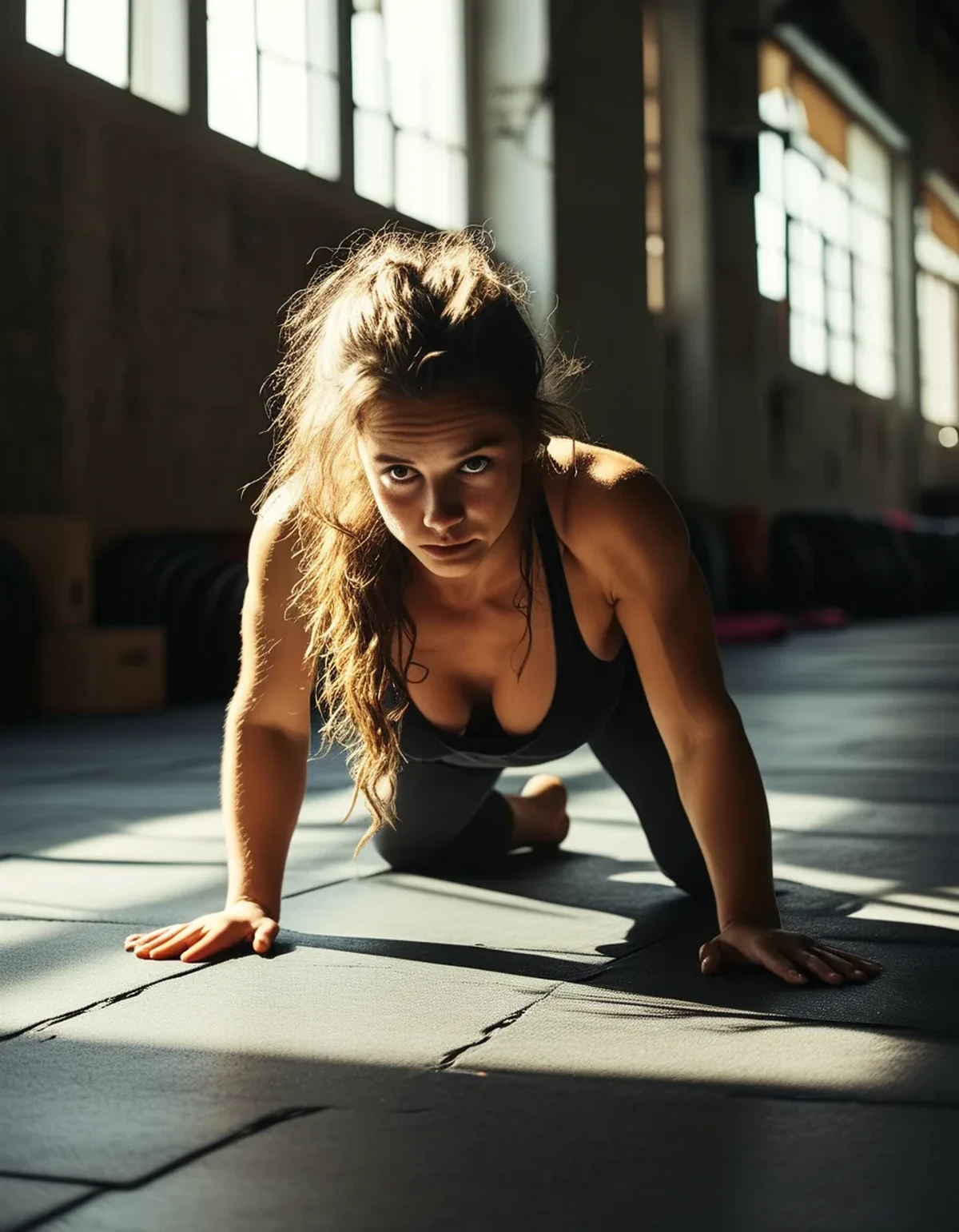
The anterior core resists extension. With the knees hovering, gravity pulls the hips down and the lower back toward an arch. Holding a flat back is a continuous anti-extension task, functionally similar to a moving plank.
The obliques resist rotation, and this is the real work. In a contralateral crawl - opposite hand and foot moving together, which is the correct pattern - the body constantly wants to rotate, and the obliques prevent it. The instruction to keep a cup of water balanced on the low back is not decorative; it is testing exactly this.
Hips and quads hold the knee hover. A knee an inch off the floor is a sustained isometric hip and knee flexion hold. Raising the hover from one inch to four increases the demand substantially - which is the simplest way to make crawling harder without moving faster.
And the grip and forearms fatigue faster than expected, particularly on hard floors, because the hand is bearing weight in an open position for minutes at a time.
How do I program crawling without wrecking my shoulders?
Short bouts, generous rest, and progression in the right variable.
Start with 15 to 20 seconds of work. That will feel absurdly short until you try it, at which point it will feel appropriate. Rest 45 to 60 seconds. Four to six rounds is a complete session at the start.
Progress hold time before you progress speed. Move from 20 seconds to 30 to 45 over several weeks. Crawling faster with poor position is how shoulders get irritated; crawling longer with good position is how capacity builds.
Progress in this order: duration, then hover height, then direction, then load. Backward crawling is significantly harder than forward and is the natural next step. Lateral crawling adds a different demand again. Adding external load - a weight on the back - comes last and is optional for most people.
Watch for the two failure signs. Hips rising toward a downward-dog position means the anterior core has given out. Hips swaying side to side means the obliques have. Both mean the set is over, regardless of the clock.
Build the shoulders separately. Because most people lack the shoulder endurance the position demands, plank holds, shoulder taps, and simple quadruped rocking build the base without the metabolic cost. Two minutes of quadruped rocking before crawling is a genuinely useful warm-up.
And if you have a history of shoulder or wrist problems, get a professional opinion before adding significant volume. Fists or parallettes remove wrist extension if that is the limiting factor. This is general information, not medical advice.
What Nobody Tells You About Crawling
Wrists fail before anything else for most beginners. Not fitness, not shoulders - wrist extension tolerance. Crawling on fists or on parallettes removes this entirely and lets you train the thing you were actually trying to train.
The contralateral pattern is not optional. Moving the same-side hand and foot together is easier and trains almost nothing, because it removes the anti-rotation demand that is the whole point. If crawling feels easy, check which pattern you are using.
Head position changes everything. Looking up at the horizon extends the neck and encourages the hips to rise. Eyes down and slightly ahead, neck neutral keeps the whole chain organised.
Breathing is the hidden limiter. Because the trunk is under continuous tension, most people brace and hold their breath. Ninety seconds of held breath produces the feeling of complete exhaustion regardless of your conditioning. Deliberately breathing through the set changes the experience dramatically.
Surface matters more than you would expect. Carpet grips and increases the work. A smooth floor lets the feet slide and reduces it. Grass outdoors is uneven and adds a stability demand. Same crawl, three different exercises.
And crawling is one of the few movements where getting fitter makes it feel easier fast. The skill component is large, so the improvement in weeks two through six is dramatic - much more so than in running. That early progress is genuinely motivating.
FAQ: Crawling Questions, Answered
Is crawling actually good for you or just hard?
Both. It builds shoulder stability, trunk anti-rotation strength, and conditioning simultaneously, in very little time and with no equipment. The evidence for specific claims about brain benefits is thin; the evidence that it is demanding, low-impact, full-body work is not in doubt.
How does it compare to running for fitness?
Different tools. Crawling produces high heart rates in short bouts with a large strength component; running builds sustained aerobic capacity. Crawling will not replace steady aerobic work, but it is excellent for conditioning when time or space is limited.
My shoulders are sore in an odd spot afterwards - is that normal?
Soreness under the armpit and around the shoulder blade is common when starting, because the serratus is rarely trained elsewhere. Sharp joint pain, pain at the front of the shoulder, or anything that persists is different - reduce volume and seek an assessment if it continues.
TL;DR:
- Crawling recruits far more muscle simultaneously than running and returns almost no elastic energy.
- Continuous isometric holding in the shoulders, trunk, and hips is what spikes perceived effort.
- Use 15 to 20 second bouts with full rest, and progress duration before speed.
- Contralateral pattern, eyes down, hips level - and stop the set when the hips rise or sway.
- Wrists usually fail first; crawl on fists or parallettes to keep training the real target.
Try four rounds of twenty seconds this week with a full minute of rest. It will be harder than it reads.
Keep Reading
This article is for general informational and styling purposes only. Fit, sizing, and product availability may vary.