Why Primal Movement Exposes Weaknesses Strength Training Hides
Quick Answer: Primal movement feels disproportionately hard because it demands contralateral coordination, end-range joint control and continuous stabilisation — three qualities that barbell training deliberately minimises. A squat is one plane, one rhythm, with the load supported by a fixed path. A crawl is multi-planar, asymmetric and unsupported. Strong people struggle with it because strength is not the limiting factor; motor control at unfamiliar joint angles is.
You can squat your bodyweight for reps.
A forty-second bear crawl leaves your shoulders trembling and your brain confused.
Both of those things are true at once, and neither is a contradiction.

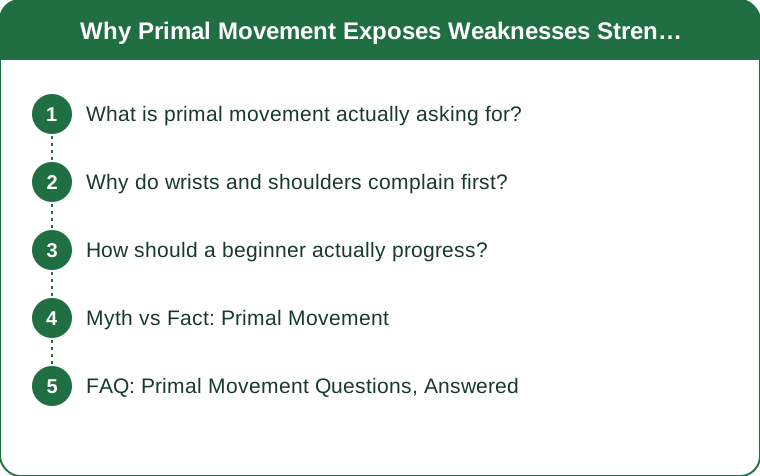
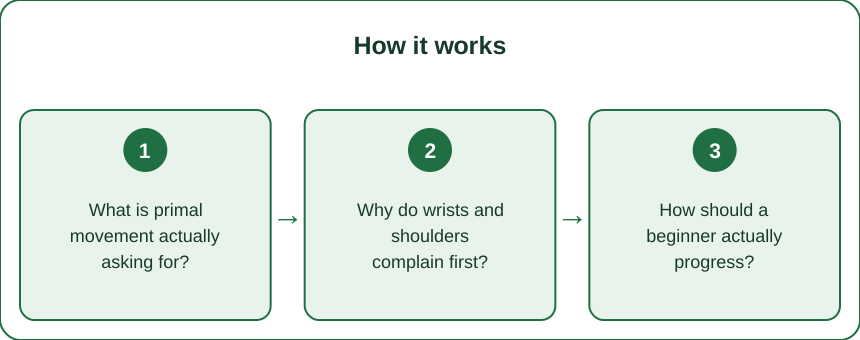
What is primal movement actually asking for?
Three demands, all largely absent from conventional lifting.
Contralateral coordination. Opposite arm and leg moving together requires cross-body neural coordination that lifting rarely trains. This is why crawling feels mentally taxing, not just physically.
End-range joint control. Deep squats, crawls and rolls place shoulders, hips and ankles near the edge of their range under load. Lifting deliberately works in the strong middle of the range.
Continuous stabilisation. There is no rack position, no fixed bar path and no rest between reps. The stabilisers work continuously rather than in bursts.
Unfamiliar loading directions. Crawling loads the shoulder in a closed-chain, weight-bearing position most adults have not used since childhood.
Simultaneous cognitive load. Remembering the pattern while producing it splits attention, which is why the first few sessions feel harder than they should.
And the wrists get exposed first. Most adults have not loaded an extended wrist under bodyweight in decades, and it is very often the first thing to fail.
Why do wrists and shoulders complain first?
Because they are being asked for something modern life never requests.
Wrist extension under load is genuinely rare. Sitting at a desk, the wrist is neutral or slightly extended but unloaded. A crawl asks for near-90-degree extension bearing a large fraction of bodyweight.
The shoulder is working closed-chain. Pressing and rowing are mostly open-chain. Weight-bearing through the hand changes which stabilisers are recruited entirely.
The serratus anterior is usually the weak link. It controls scapular position in weight-bearing and is undertrained in most lifting programmes.
Tissue capacity lags strength. Tendons and connective tissue adapt more slowly than muscle, so the strong lifter has muscular capacity the connective tissue has not caught up to in this specific position.
Build the wrists deliberately. Start on fists or parallettes to reduce extension, then progress to flat palms over several weeks.
Progress crawls by time, not distance. 20 to 30 seconds of quality is a complete first set. Adding distance while form degrades is how wrists get irritated.

How should a beginner actually progress?
Slower than seems necessary, and in a specific order.
Weeks 1 to 2: static holds. Hold the bear position — knees hovering 5cm off the floor — for 15 to 20 seconds, three to four times. No movement at all until this is comfortable.
Weeks 3 to 4: add movement in place. Shift weight side to side, then lift one hand, then one foot. Still no travel.
Weeks 5 to 6: forward crawling, short distances. Three to five metres, focusing on keeping the hips level.
Then add direction and variation. Backward, lateral, and other patterns once forward is stable.
Keep sessions short and frequent. 10 to 15 minutes, three times a week builds this far better than one long session, because the adaptation is largely neural.
Late-summer note: this is one of the few training styles that needs no equipment and no gym, which makes it well suited to the shoulder season when outdoor training is still pleasant but routines are about to change. A patch of grass is the ideal surface — forgiving on wrists, and it makes sloppy hand placement obvious.
Myth vs Fact: Primal Movement
Myth: it is a complete replacement for strength training. Fact: it builds coordination, mobility and stability, but it does not progressively overload well. It complements lifting rather than replacing it.
Myth: humans are ‘meant’ to move this way. Fact: the framing is marketing. The exercises are useful because they train underused patterns, not because of any ancestral obligation.
Myth: if you are fit it should be easy. Fact: it is a separate skill. Very strong people are routinely humbled by it, and that is the point rather than a problem.
Myth: soreness in odd places means you did it wrong. Fact: it means you used muscles that lifting leaves alone. Serratus, deep hip rotators and forearms are the usual suspects and it is entirely expected.
Myth: barefoot is required. Fact: barefoot helps with foot and toe engagement, but if your feet are unaccustomed, build up gradually. Sudden barefoot volume is a reliable way to irritate the plantar fascia.
Myth: more is better. Fact: this is skill work. Quality degrades quickly, and a degraded crawl trains a degraded pattern. Stop when the shape falls apart, not when you are tired.
FAQ: Primal Movement Questions, Answered
How often should I do it?
Three sessions of 10 to 15 minutes weekly is plenty. It layers well onto existing training as a warm-up or a separate short session.
My wrists hurt. Should I stop?
Stop that variation and regress to fists or parallettes. Wrist pain that persists beyond the session deserves attention rather than persistence.
Will it build muscle?
Minimally after the initial period. It builds control, stability and mobility. Use resistance training for hypertrophy.
Why am I so out of breath from crawling?
Crawling recruits a very large amount of muscle simultaneously and elevates heart rate faster than most people expect. This is normal.
Is it good for back pain?
Many people find ground-based work helpful because it trains trunk stability without spinal loading, but it is not a treatment. See a physiotherapist for persistent pain.
What surface is best?
Grass or a firm mat. Hard floors are unkind to wrists and knees; very soft mats make hand placement unstable.
This is general information, not medical advice.
TL;DR:
- Primal movement demands contralateral coordination, end-range control and continuous stabilisation — qualities lifting deliberately minimises.
- Wrists and shoulders complain first because weight-bearing in extension is a pattern most adults have abandoned.
- Progress with static holds first, then movement in place, then travel — over about six weeks.
- Keep sessions to 10 to 15 minutes, three times weekly; this is skill work, not conditioning.
- Odd-location soreness is expected, not a sign of error.
Start with a 20-second bear hold, three times. If that is easy on day one, you are the exception.
Keep Reading
This article is for general informational and styling purposes only. Fit, sizing, and product availability may vary.