Why Primal Movement Feels Easy and Then Wrecks You the Next Day
Quick Answer: Primal movement patterns load muscles in deep ranges and unfamiliar positions that standard gym training rarely reaches. Novel loading at long muscle lengths produces disproportionate delayed soreness, so a session that felt genuinely easy can leave you noticeably sore 24-48 hours later.
You crawled around for twenty minutes. Your heart rate barely moved. You considered adding a second round. Two days later you discovered muscles between your ribs you had no prior relationship with.

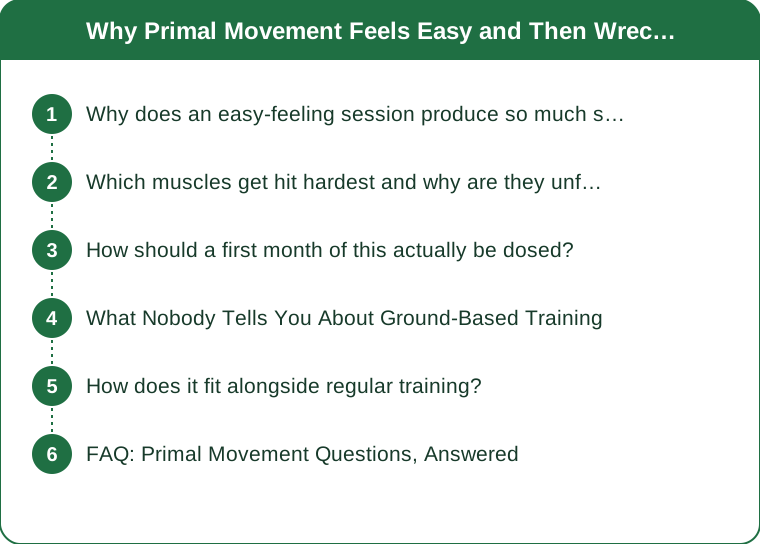
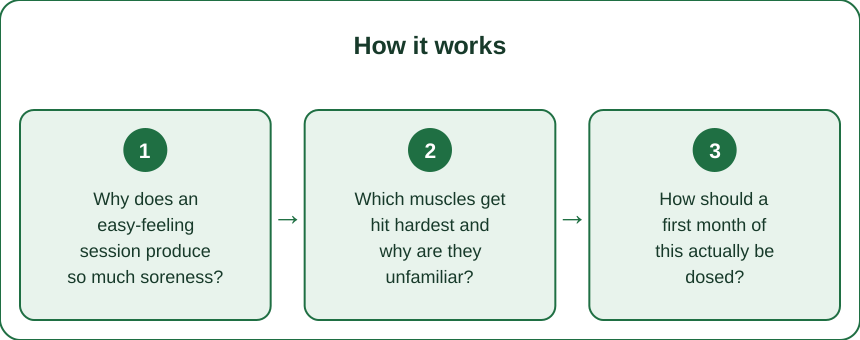
Why does an easy-feeling session produce so much soreness?
Perceived effort during a session tracks cardiovascular and metabolic demand fairly well. Delayed soreness tracks something different: mechanical stress on muscle fibers, especially eccentric loading and loading at long muscle lengths.
Primal patterns — deep squats, crawling, ground transitions, rotational movement — are full of positions where muscles are working while lengthened. Loading a muscle near its end range appears to produce more microdamage than the same work at mid-range, and it’s a category of stress that produces almost no burn in the moment. Low burn, high damage, delayed bill.
Which muscles get hit hardest and why are they unfamiliar?
The ones conventional training systematically underloads: deep hip rotators, obliques and the rest of the anti-rotation system, serratus anterior, and the small stabilizers of the shoulder blade.
Machine-based and even most barbell training moves in predictable planes with the torso braced. Crawling requires continuous anti-rotation work through the trunk while the shoulder blade moves freely on the ribcage — a combination almost nothing else in a typical program asks for. That’s why the soreness lands in places that feel novel rather than in quads and glutes.
How should a first month of this actually be dosed?
Far shorter than it feels like it should be. Ten to fifteen minutes is a reasonable first session, and the honest guideline is to stop while it still feels easy, because the in-session feedback is misleading by design.
The standard progression logic applies: increase by roughly 10% per week, and treat the repeated bout effect as your friend. After two or three exposures to a pattern, soreness from that pattern drops sharply. The trap is that the first session’s lack of difficulty invites doing four times too much.

What Nobody Tells You About Ground-Based Training
Wrist discomfort is the most common early limiter, not strength. Loaded wrist extension is unfamiliar for most people, and building tolerance takes a few weeks. Fists or parallettes are a legitimate bridge.
Soreness between the ribs is normal. Serratus and intercostal soreness after crawling surprises nearly everyone, and is not a sign of injury.
Doing it on carpet changes the exercise. Softer surfaces increase stabilization demand at the shoulder considerably. If a flow felt fine on a mat and brutal on carpet, that’s why.
It exposes side-to-side differences that lifting hides. Bilateral gym work lets a stronger side compensate; crawling generally doesn’t.
The mobility gains are the real product. Strength gains from primal work are modest compared to loaded training. The unique value is in the ranges — which is a reason to program it alongside lifting rather than instead of it.
How does it fit alongside regular training?
As a complement, not a replacement, and placed with some care. Because it loads long muscle lengths eccentrically, stacking it directly before heavy lifting compromises the lifting, and stacking it directly after adds fatigue to already-damaged tissue.
The cleanest placements are on a separate day, or as a 10-minute movement warm-up at low intensity. Two dedicated sessions a week is plenty for most people, with at least 48 hours between them in the first month while the repeated bout effect is still building.
FAQ: Primal Movement Questions, Answered
Is being this sore a sign I did it wrong?
Not by itself. Novel movement at long muscle lengths reliably produces significant delayed soreness in the first few sessions, and it drops off quickly with repeat exposure. Sharp pain during movement is a different signal entirely.
How long until the soreness stops being extreme?
Usually two to three exposures to a given pattern. The repeated bout effect is well documented and fast.
Do I need a specific surface or shoes?
A firm surface and bare feet or minimal shoes are typical, mainly because foot and ankle involvement is part of the point. A thin mat is enough for knee comfort.
TL;DR:
- Perceived effort tracks metabolic demand; soreness tracks mechanical stress at long muscle lengths
- Primal patterns load exactly the ranges conventional training skips
- Start at 10-15 minutes and stop while it still feels easy
- Wrists are usually the first limiter, and rib-area soreness is normal
- Program it alongside lifting, not as a replacement — the mobility is the real product
Dose the first month by the clock rather than by feel. The feel is the least reliable signal this style of training gives you.
Keep Reading
This article is for general informational and styling purposes only. Fit, sizing, and product availability may vary.