Why Your Grip Fails Before Your Shoulders in Hanging Work
Quick Answer: Hanging loads your whole bodyweight through a small cross-sectional area of forearm flexor muscle working isometrically, with restricted blood flow because the sustained contraction compresses its own circulation. Your shoulders and lats are working at a much smaller fraction of their capacity, so the forearms reach failure first. It is not a weakness problem so much as an endurance and blood-flow problem - and it responds quickly to the right kind of training.
Here is why the grip is the bottleneck, and how to move it.

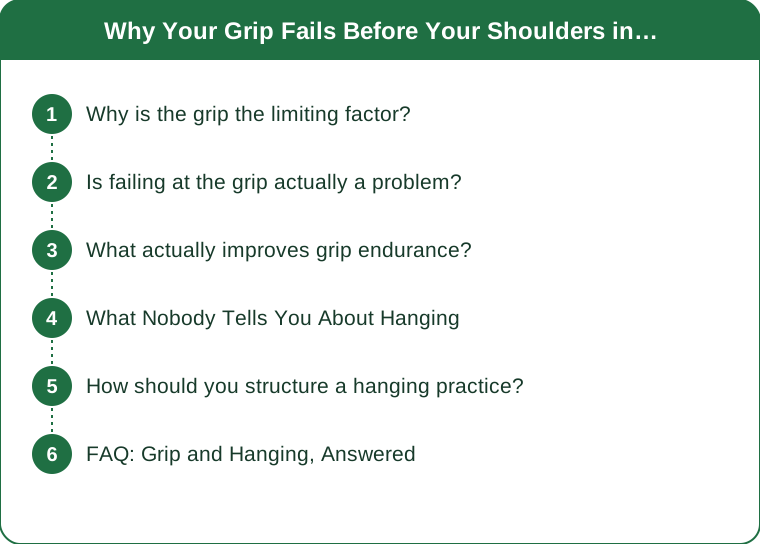
Why is the grip the limiting factor?
Four reasons, stacked.
The muscles are small relative to the load. The finger flexors in your forearm are supporting your entire bodyweight through tendons that run all the way to your fingertips. The shoulder girdle and lats supporting the same load are vastly larger muscles working at a much lower percentage of their maximum.
Isometric contraction restricts its own blood supply. A sustained hard contraction compresses the blood vessels running through the muscle. Above roughly 50 to 60 percent of maximum voluntary contraction, blood flow is substantially occluded - so the muscle is working hard while receiving less oxygen and clearing less waste. Fatigue accelerates sharply.
There is no rest phase. In most exercises there is a moment of lower tension in each rep where blood flows again. A hang has no such moment, which is why 40 seconds of hanging feels harder than a much longer set of most other things.
And the grip is trained less than anything else in a typical programme. Straps, machines, and padded handles all remove grip demand from other exercises. Most people’s grip endurance is simply undertrained relative to their pulling strength, and hanging is where that gap becomes visible.
The good news is that this responds quickly. Grip endurance improves noticeably within a few weeks of direct work, partly through neural adaptation and partly through improved local blood flow and fatigue resistance - faster than most strength qualities.
Is failing at the grip actually a problem?
Sometimes it is exactly what you want, and sometimes it defeats the purpose.
If your goal is grip strength, grip failure is the point. Hanging is one of the most effective grip endurance exercises available, and stopping when the hands give out means you trained the target.
If your goal is shoulder health, decompression, or lat stretch, grip failure ends the session early and you never reach a useful duration for the tissue you were trying to load. This is the frustrating case, and it is the one most people are in.
Which points to the fix: separate the two goals. Use straps or hooks for the shoulder-focused hangs, and hang without assistance when grip is the target. This is not cheating - it is training the thing you meant to train.
There is a third possibility worth checking: shoulder position. If your shoulders are completely passive in a dead hang, more of the load runs into the tissue passively. An active hang - shoulders gently engaged, slightly depressed - distributes the load into muscle and is more appropriate for many people, particularly anyone with shoulder discomfort.
And a fourth: bar thickness. A thick bar dramatically increases grip demand. A standard bar is easier to hold than a thick one, and if your bar at home is unusually thick, that alone may be your limiting factor rather than your grip capacity.
What actually improves grip endurance?
Direct work, and it is simpler than the equipment market suggests.
Hang more often, for shorter durations. Frequency beats intensity for this. Three to five short hangs a day, most days, produces faster progress than one long session weekly. Accumulated time under tension is what drives the adaptation.
Use a mix of hang types. Dead hangs for maximum duration, active hangs for shoulder engagement, and single-arm assisted hangs for higher load per hand. Variety loads the tissue differently.
Add thick-bar or towel hangs once basic hangs are comfortable. A towel over the bar increases grip diameter and demand substantially. This is the cheapest grip-strength upgrade available.
Train the release, not just the hold. Farmer’s carries, plate pinches, and heavy holds all build the same system in different positions, and carries in particular transfer well because the demand is sustained.
Stop before total failure, most of the time. Hanging to complete failure repeatedly is hard on the finger tendons and pulleys. Ending most sets a few seconds short leaves you able to train tomorrow, which matters more than any individual session.
And progress on time before load. Add seconds first, then thickness, then single-arm work. A common milestone benchmark is 30 seconds for beginners, 60 seconds as a solid general target, and progress toward it is usually much faster than people expect.
One thing that helps immediately: your thumb. A full grip with the thumb wrapped is substantially stronger than a false grip with the thumb over the bar. Many people hang with an open thumb without realising it - and wrapping it is a free improvement.

What Nobody Tells You About Hanging
Skin is often the real limit, not muscle. Beginners frequently stop because their palms hurt, not because their grip failed. This resolves with a few weeks of consistent hanging as the skin adapts - and it is not a reason to conclude your grip is weak.
Bodyweight matters enormously and nobody accounts for it. Grip endurance in a hang is a bodyweight-relative measure. Comparing hang times between two people of different sizes tells you very little, and comparing yourself to a video is worse.
Your grip is weaker at the end of the day. After a day of typing, carrying, and using your hands, forearm endurance is measurably reduced. The same hang genuinely feels harder in the evening, which is worth knowing before you conclude you are regressing.
Finger tendon and pulley injuries are the real risk, and they come from too much too soon - especially single-arm hangs, sudden drops, and hanging with a fully straight arm and disengaged shoulder under high load. Progress in weeks, not sessions.
Hanging does not decompress the spine in the way it is often claimed to. It does load the shoulder girdle and stretch the lats and thoracic tissue, which is genuinely valuable - but the more dramatic claims about spinal height and disc rehydration are not well supported and are not the reason to do it.
Warm hands hold on longer. Cold hands lose grip strength markedly, which is why hangs feel much harder in a cold garage in autumn than they did in the same garage in July. Warm up your hands first and the comparison becomes fair again.
And the one that surprises people: breathing. Most people hold their breath while hanging, which accelerates fatigue considerably. Breathing normally throughout adds meaningful time for no extra strength.
How should you structure a hanging practice?
Small, frequent, and progressed slowly.
Week 1 to 2: accumulate time. Aim for 60 to 90 seconds of total hanging per day, broken into as many short hangs as you need. Feet lightly supported on a box is a completely legitimate starting point and lets you accumulate time while the hands adapt.
Week 3 to 6: build single-hang duration. Work toward a single 30-second hang, then toward 45. Keep total daily volume similar and let the individual hangs get longer.
Week 6 onward: add variety and demand. Towel hangs, thicker bar, active hangs with scapular engagement, assisted single-arm work with one hand on the wrist of the other.
Throughout: stop when form changes. Shoulders shrugging up to the ears, the body starting to swing, or fingers beginning to open are all stop signals. Ending the set there is the correct decision, not a failure of will.
Rest at least a couple of minutes between hangs, and take a full day off if your forearms or fingers are sore. Tendons adapt more slowly than muscle - this is the single most important principle in grip training, and the reason most injuries here are progression errors.
And integrate rather than isolate. Carries, pull-ups without straps, kettlebell work, and even carrying the shopping in one trip all contribute. Grip is one of the few qualities where daily-life loading genuinely counts toward the training effect.
This is general fitness information, not medical advice. If you have shoulder pain, a history of shoulder instability or rotator cuff injury, elbow pain, or any finger or wrist injury, get assessment before adding hanging work - and stop immediately if you feel sharp pain in a finger, which can indicate a pulley injury rather than ordinary fatigue.
FAQ: Grip and Hanging, Answered
Why do my hands give out before my shoulders?
The forearm flexors are small muscles supporting your full bodyweight isometrically, and sustained contraction restricts their own blood flow. Your shoulders and lats are far larger and working at a much lower percentage of their capacity.
Is it cheating to use straps?
Not if the goal is shoulder work or lat stretch. Straps let you train the tissue you actually intended to train. Save unassisted hangs for when grip itself is the target.
How long should I be able to hang?
Common benchmarks are around 30 seconds for beginners and 60 seconds as a solid general target, but this is heavily influenced by bodyweight, bar thickness, and how recently you used your hands.
Why does it feel harder in the evening?
Forearm endurance is measurably reduced after a day of using your hands. Cold hands also lose grip strength noticeably, which is why hangs feel harder in a cold space as the season turns.
How often should I hang?
Frequently and briefly - three to five short hangs most days beats one long weekly session. Total accumulated time under tension is what drives the adaptation.
My palms hurt more than my forearms - is that normal?
Very. Skin is often the limiting factor for the first few weeks and it adapts with consistent practice. It is not evidence that your grip is weak.
Does hanging decompress my spine?
It loads the shoulder girdle and stretches the lats and thoracic tissue, which is genuinely valuable. The stronger claims about spinal decompression and disc rehydration are not well supported and are not the main reason to hang.
TL;DR:
- Small forearm flexors carry your whole bodyweight isometrically, and sustained contraction restricts their own blood supply - so they fail long before your shoulders do.
- A hang has no rest phase, which is why 40 seconds feels harder than much longer sets of other exercises.
- If the goal is shoulder or lat work, use straps. If the goal is grip, hang unassisted. Separating them is not cheating.
- Train it with frequency, not intensity - three to five short hangs most days beats one long weekly session.
- Wrap your thumb, breathe normally, and warm your hands - three free improvements most people are missing.
- Progress time first, then bar thickness, then single-arm work. Tendons adapt slower than muscle.
- Skin is often the real limit in the first weeks, and grip is genuinely weaker in the evening and in cold weather.
Stop when your shoulders shrug or your fingers start to open - that is the signal, not a failure of will.
This is general information, not medical advice.
Keep Reading
This article is for general informational and styling purposes only. Fit, sizing, and product availability may vary.