Why Your Shoulders Hurt During Crawling Exercises (And What That's Actually Telling You)
Quick Answer: Shoulder discomfort during crawling is most often caused by hand placement too far forward of the shoulders and insufficient shoulder blade engagement (protraction), not a sign that crawling itself is bad for your shoulders — correcting hand position resolves it for most people within a few sessions.
You added crawling to your routine because everyone said it was great for shoulder health, and now your shoulders are the one thing that hurts every single time.

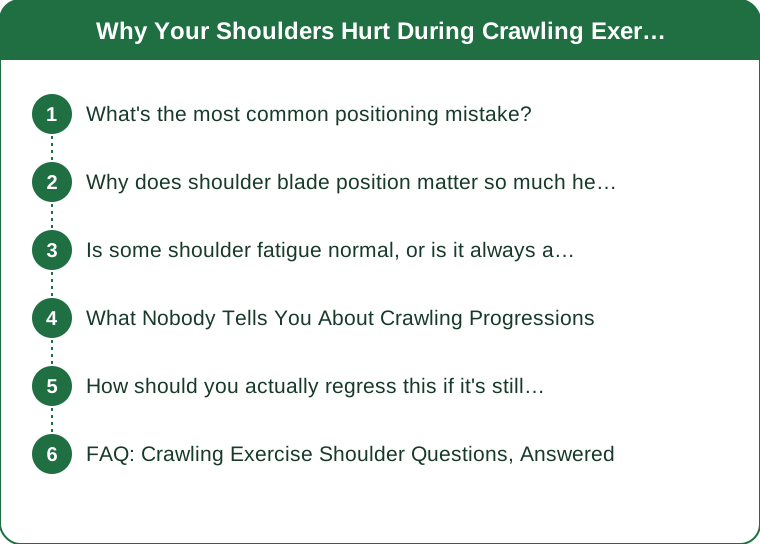
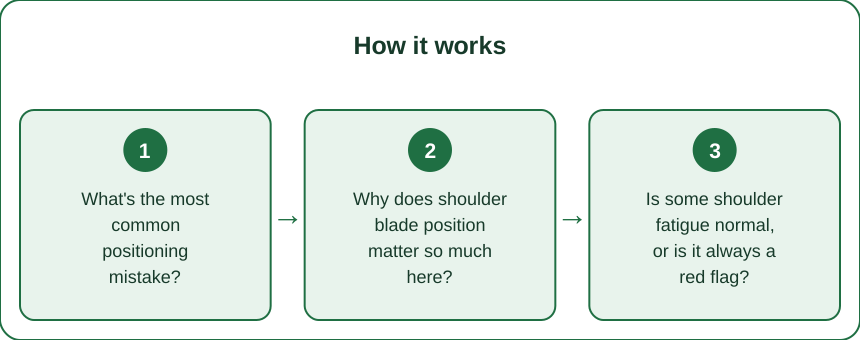
What’s the most common positioning mistake?
Placing hands too far in front of the shoulders — a habit carried over from push-up form — puts crawling joints into a mechanically disadvantaged angle, loading the front of the shoulder joint more than the surrounding stabilizing muscles can handle comfortably.
Hands should land roughly under or just slightly ahead of the shoulders, not extended out in front — this keeps the load traveling through the joint in a stacked, supported line rather than a shearing angle.
Why does shoulder blade position matter so much here?
Crawling asks your shoulder blades to actively protract — spread away from the spine and wrap around the ribcage — rather than staying pinched back like in most pulling exercises. Without training this movement, the shoulder joint takes on stabilizing work that the shoulder blade muscles should be doing instead.
Many beginners unconsciously keep their shoulder blades pinched back out of habit from other training, which locks the shoulder into a position crawling wasn’t designed to load that way.
Is some shoulder fatigue normal, or is it always a red flag?
General muscular fatigue — a tired, worked feeling in the front of the shoulder and upper chest after a crawling session — is normal, especially early on, since crawling loads the shoulder in a way most routines don’t. Sharp, pinching, or joint-line pain during the movement itself is different and is the actual signal to stop and check positioning rather than push through.

What Nobody Tells You About Crawling Progressions
Most people jump straight to moving bear crawls before mastering a static loaded quadruped hold — simply holding the top-of-crawl position for 20-30 seconds with correct shoulder blade protraction. Skipping this step means you’re trying to learn positioning and movement simultaneously, which is much harder than separating the two.
Also underrated: crawling on an unstable or overly soft surface (thick gym mats, sand) changes the stabilization demand significantly — if your shoulders hurt on soft surfaces but not on a firm floor, the surface itself, not your form, may be the variable.
How should you actually regress this if it’s still uncomfortable?
Wall-supported shoulder protraction drills (a plank-like push against a wall, focusing purely on shoulder blade movement without full bodyweight load) let you build the specific stabilization pattern crawling needs without the joint stress of full quadrupedal loading. Once that feels controlled, move to short static holds on the floor before adding movement.
FAQ: Crawling Exercise Shoulder Questions, Answered
How long before shoulder discomfort from crawling should resolve with better form?
Most people notice meaningful improvement within 2-3 sessions of consciously correcting hand placement and shoulder blade position.
Should I stop crawling completely if my shoulder hurts?
Sharp or pinching pain warrants stopping that session and reassessing form or consulting a professional; general fatigue soreness does not require stopping.
Are there crawling variations that are gentler on the shoulders?
Yes — a bird-dog or quadruped hold with less bodyweight shifted forward reduces shoulder load while still building the underlying stability pattern.
This is general information, not medical advice — persistent or worsening joint pain should be evaluated by a professional.
TL;DR:
- Hands placed too far forward is the most common cause of crawling shoulder discomfort
- Shoulder blade protraction is a trained skill crawling specifically requires
- Sharp joint pain means stop and reassess form; general fatigue is normal
- Master a static loaded hold before progressing to full moving crawls
Keep Reading
This article is for general informational and styling purposes only. Fit, sizing, and product availability may vary.