Why Your Wrists Give Out Before Anything Else in Primal Movement
Quick Answer: Ground-based movement requires the wrist to bear load near end-range extension, a position most adults never load. The limiting factor is usually tissue tolerance rather than strength or flexibility, and it builds with graded exposure over weeks. Start on fists or parallettes to reduce the extension angle, add short daily loaded holds, and progress by time before adding movement.
The crawling looked easy. Two minutes in, your shoulders were fine and your wrists were screaming. That is not a sign you are weak. It is a sign that particular tissue has had nothing asked of it since childhood.

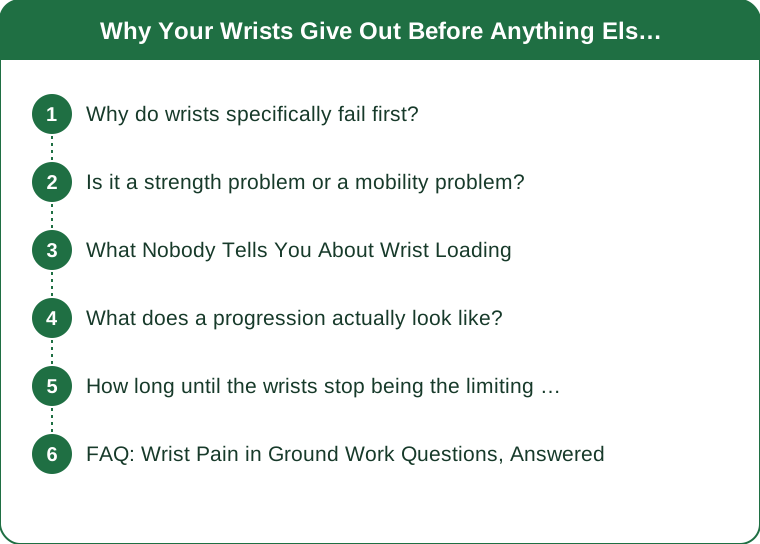
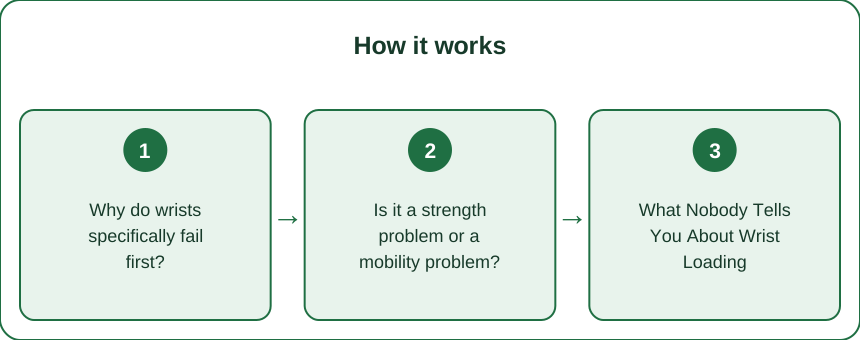
Why do wrists specifically fail first?
Because of the joint angle and the complete absence of prior loading.
A hand planted flat on the floor puts the wrist at roughly 90 degrees of extension, which is at or near the end of most people’s available range. Loading a joint at end-range is inherently more demanding than loading it mid-range, because the passive structures take more of the force.
At the same time, the wrist in a modern adult life bears essentially no weight. Your shoulders carry bags, your hips and knees carry your body, your spine handles load constantly. The wrist types, holds a phone, and opens jars.
So you are asking a joint with no loading history to bear a substantial fraction of your body weight at end range, while also stabilizing against movement. It is the least prepared structure in the chain by a wide margin.
The encouraging part is that tissue tolerance is highly trainable and responds relatively quickly, often noticeably within three to four weeks of consistent short exposures. This is not a mobility problem that takes a year.
Is it a strength problem or a mobility problem?
Usually tolerance, which is neither exactly.
Mobility matters if you genuinely cannot reach 90 degrees of wrist extension. Test it: kneel and place your palms flat with fingers pointing forward, then gently shift weight forward. If your palms lift off the floor before your forearms approach vertical, you have a range restriction and that needs addressing first.
Most people have the range and still hurt, which points at tolerance: the capacity of the tendons, ligaments, and joint structures to accept load in that position repeatedly. Tolerance is built by graded exposure, not by stretching.
Strength of the forearm muscles contributes, particularly the wrist flexors and extensors that stabilize the joint under load, and direct forearm work does help. But it is secondary to simply spending time bearing weight in the position.
The practical distinction matters because it determines what you do. A mobility problem gets stretching and joint work. A tolerance problem gets short, frequent, progressively longer loaded holds, and stretching does close to nothing for it.
What Nobody Tells You About Wrist Loading
Finger position changes the load distribution significantly. Fingers spread wide with active pressure through the fingertips shares load away from the heel of the hand. Passive flat hands dump everything into the wrist joint. This single cue resolves a lot of complaints.
Turning the hands out slightly reduces the extension demand. Rotating the hands 15-30 degrees outward changes the angle at the wrist and is a legitimate modification rather than cheating. Many people can hold twice as long this way.
Fists are the underrated regression. A closed fist with a neutral wrist removes the extension entirely while keeping the loading. This lets you build shoulder and core capacity in crawling patterns while the wrists catch up separately.
Parallettes or dumbbells accomplish the same thing with a more comfortable grip, and they are worth the small cost if ground work is a regular part of your training.
And the one that surprises people most: the pain often peaks in week two and then improves rapidly. Tissue adapting to new loading goes through a period of feeling worse before tolerance builds. Provided the pain is a diffuse ache that settles within a few hours and does not worsen session to session, working through that phase with sensible volume is normal. Sharp, localized, or persistent pain is a different signal.

What does a progression actually look like?
Four stages, progressing by time before adding difficulty. Daily short exposures beat twice-weekly long ones.
Stage 1: kneeling hands-on-floor holds. Hands under shoulders, knees down, minimal weight forward. Hold 20-30 seconds, three times, daily. Increase weight shift gradually rather than time at first.
Stage 2: quadruped holds. Hands and knees, weight distributed normally. Build to 60 seconds, three sets. Add slow weight shifts side to side and front to back once the hold is comfortable.
Stage 3: bear position holds. Knees lifted an inch off the floor. This substantially increases the load. Start at 15-20 seconds and build.
Stage 4: movement. Crawling, transitions, and flow work. Only once you can hold stage 3 comfortably for 45 seconds, because movement adds unpredictable loading that a static hold does not.
Alongside this, add direct forearm work twice a week: wrist curls and extensions with light weight, and pronation and supination with a light dumbbell held at one end. Two sets of 15 each, and light genuinely means light.
And always warm the wrists before loading them. Thirty seconds of circles, gentle flexion and extension, and a few seconds of the loaded position at low intensity does more to prevent the ache than anything you do afterward.
This is general information, not medical advice. Wrist pain with numbness, tingling into the fingers, pain that persists at rest, or a history of wrist injury should be assessed before loading.
How long until the wrists stop being the limiting factor?
Most people find that short daily exposures produce noticeable change in three to four weeks and a genuine shift in four to eight.
The reason it works quickly is that you are starting from zero. Tissue with no loading history adapts fast at first, in the same way a complete beginner in the gym progresses faster than an experienced lifter.
What slows people down is inconsistency and doing too much at once. A single 20-minute crawling session once a week produces soreness and little adaptation. Three minutes a day produces adaptation and almost no soreness.
It is also worth knowing that wrist tolerance is somewhat position-specific. Building tolerance in a bear crawl does not fully transfer to a bridge or a crab position, where the wrist is loaded in extension with the fingers pointing away from the body. Expect to build each position somewhat separately, and do not be surprised when a new position feels like starting over.
Once the wrists stop being the limiting factor, most people discover their actual limiting factor was somewhere else all along, usually shoulder endurance or the deep core. That is a good problem and it was hidden underneath the wrist complaint the whole time.
FAQ: Wrist Pain in Ground Work Questions, Answered
Should I use wrist wraps?
For heavy lifting, sometimes. For ground-based movement, generally no. The point is to build tolerance in the tissue, and support removes the stimulus that produces adaptation. Use fists or parallettes as a regression instead.
Why do my wrists hurt more the day after than during?
That pattern suggests tissue loading rather than a joint problem, and it is the normal response to a new stimulus. Reduce the volume by about a third and keep the frequency, which is almost always the right adjustment.
Is typing making this worse?
It does not help. Hours of static wrist extension with no loading builds no tolerance while keeping the tissue in a shortened position. Regular wrist circles and gentle extension breaks through a working day complement the loading work rather than replacing it.
TL;DR:
- Ground work loads the wrist at end-range extension, a position adults never otherwise load
- The limiting factor is usually tissue tolerance, not mobility or strength, and tolerance builds with graded exposure
- Spread the fingers, turn the hands out slightly, and use fists or parallettes as legitimate regressions
- Three minutes daily beats twenty minutes weekly; expect a real shift in three to four weeks
Stop pushing through the crawl and start doing 30-second kneeling holds every morning. In a month the wrists will be the last thing you notice.
Keep Reading
This article is for general informational and styling purposes only. Fit, sizing, and product availability may vary.